Architecture
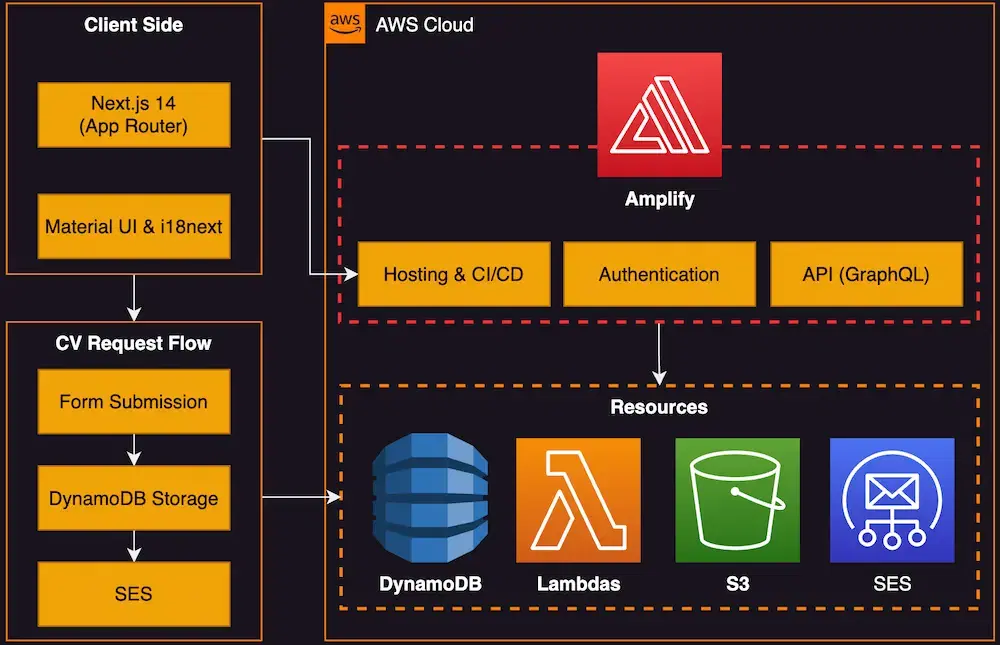
This website leverages Next.js for server-side rendering to optimize SEO performance, AWS Amplify for cost-effective serverless backend operations, and DynamoDB for fast, scalable data retrieval with minimal latency.
Diagram
🚀 Framework
The frontend is built with Next.js 14 using the App Router architecture. Components are organized following atomic design principles, with reusable UI elements and page-specific components.
🎨 UI Components
Material UI provides a consistent design system with responsive components that adapt to any screen size. The theme system allows for seamless light/dark mode switching.
📝 Type Safety
TypeScript ensures type safety throughout the codebase, reducing runtime errors and improving developer productivity.
☁️ Hosting
The backend uses AWS Amplify for hosting and continuous deployment. API routes in Next.js provide serverless functions for handling data processing and third-party integrations.
🔒 Authentication
Authentication is handled through AWS Cognito, providing secure user management and access control.
🌐 Content Delivery
CloudFront CDN is used for content delivery, ensuring fast loading times globally.
📊 NoSQL Database
Data is stored in Amazon DynamoDB, a NoSQL database service that provides fast and predictable performance with seamless scalability.
🗄️ Storage
S3 buckets are used for storing static assets like images and documents, with proper CORS configuration to ensure secure access.
⚡ Performance
Data access patterns are optimized for common queries, with appropriate indexes to ensure efficient retrieval.
🔄 Amplify CI/CD
AWS Amplify provides a fully managed CI/CD workflow that automatically builds, tests, and deploys the application on every code push. This eliminates manual deployment steps, ensures consistent environments, and enables feature branch deployments for testing before merging to production.
🪝 Husky Git Hooks
Husky is implemented to enforce code quality standards by running pre-commit and pre-push hooks. These hooks automatically run linters, type checking, and unit tests before allowing commits or pushes, preventing problematic code from entering the repository.
🏷️ GitHub Actions for PRs
GitHub Actions automatically label pull requests based on their content (e.g., "feature", "bugfix", "documentation") and run validation workflows. This improves PR organization, facilitates code review prioritization, and ensures all changes meet quality standards before merging.